Meet ArtCraft: 16 Open-Source Apps Built in Rust to Challenge Adobe and Microsoft
ArtCraft is developing 16 free, open-source applications in Rust, covering everything from photo editing and video production to spreadsheets, presentations, CAD and audio. With native desktop support, browser compatibility and AI-agent integration, the project aims to challenge established software ecosystems. Here's what the applications offer, how AI is helping build them and whether they can realistically compete with Adobe and Microsoft.
The software industry has long been dominated by established applications such as Adobe Photoshop, Premiere Pro, Microsoft Word, Excel and PowerPoint. These tools have become essential to millions of professionals, but their subscription costs, complex licensing arrangements and closed development ecosystems have also created opportunities for alternatives.
A new project called ArtCraft is taking an ambitious approach to that opportunity.
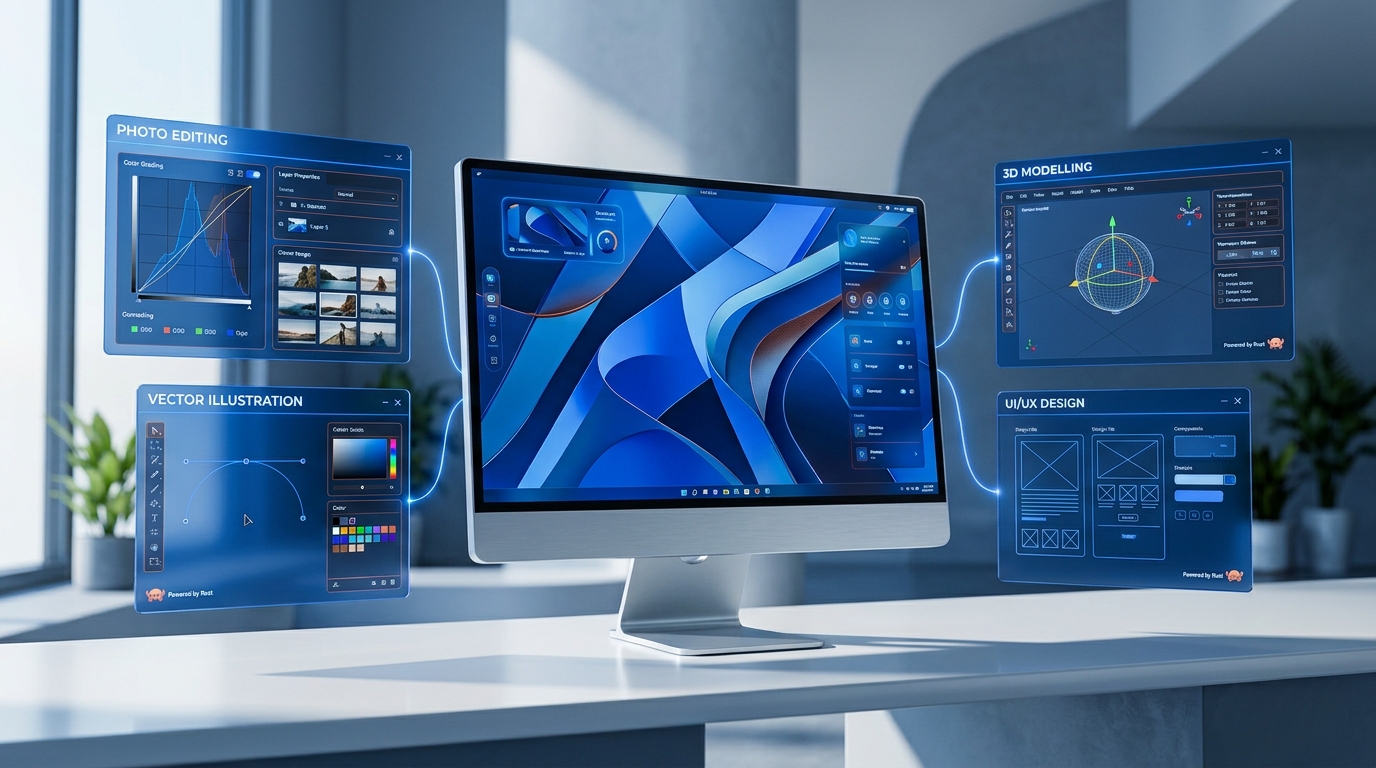
The team behind ArtCraft is developing a collection of 16 free, open-source creative and productivity applications, all built primarily in Rust. The collection includes tools for image editing, video production, vector illustration, PDF management, presentations, spreadsheets, audio production, computer-aided design and more.
Rather than developing a single application to compete with an established product, the project aims to build an entire ecosystem of native desktop software.
Its ambitions are attracting attention for another reason: the developers are using AI-assisted programming to accelerate the development of applications that traditionally require substantial engineering resources.
Although the project is still evolving, it raises interesting questions about the future of desktop software, open-source development and the role of AI coding agents.
What is ArtCraft?
ArtCraft is a software initiative building a collection of applications under what it calls its Crafting Apps ecosystem.
The project is associated with the Storytold organization on GitHub, where its applications and source code are published.
Its central idea is straightforward: develop familiar creative and productivity tools from scratch using Rust, make them open source, and provide native applications for major desktop platforms.
The collection currently includes 16 applications:
- PhotoCraft: An image editor designed for photo editing and image manipulation.
- VectorCraft: A vector illustration and graphics design application.
- FilmCraft: A nonlinear video editor for editing and producing video content.
- LightCraft: A photo library and RAW image development tool.
- PdfCraft: A PDF reader and editing workspace.
- EffectCraft: A motion graphics and visual effects application.
- DesignCraft: A page layout and publishing tool.
- FigCraft: An interface design and prototyping application.
- TextureCraft: A tool for 3D texture painting.
- MaterialCraft: A node-based procedural material designer.
- WordCraft: A word processing application.
- SoundCraft: A digital audio workstation for recording, editing and mixing.
- DeckCraft: A presentation and slideshow application.
- CADCraft: A computer-aided design and drafting tool.
- GridCraft: A spreadsheet and data analysis application.
- Craft Anything: A project designed to help users explore how software works and create their own versions.
Together, these applications cover a significant portion of the software categories commonly associated with professional creative suites and office productivity platforms.
The official ArtCraft website presents them as free, open-source applications, with individual project pages and downloadable builds. <Cite refs={["turn798811search1","turn798811search0"]}/>
Why the developers chose Rust
One of the most interesting technical decisions behind the project is its use of Rust.
Rust is a systems programming language designed around performance, memory safety and reliability. It has become increasingly popular for applications that require efficient resource management, predictable execution and close interaction with computer hardware.
These characteristics make it an interesting choice for desktop creative software.
Applications such as video editors, image processors, audio workstations and CAD tools can be computationally demanding. They need to handle large files, complex operations and sometimes intensive graphics workloads.
Rust offers developers a way to build native applications without relying on the traditional combination of web technologies and desktop wrappers used by many modern applications.
ArtCraft specifically emphasizes that its applications are native Rust software rather than Electron-based applications or websites packaged as desktop programs.
This does not automatically make them faster than competing products. Actual performance depends on implementation, algorithms, graphics pipelines, memory management and optimization.
Nevertheless, the architectural direction is notable because it places performance and native execution at the centre of the development strategy. <Cite refs={["turn798811search1","turn798811search4"]}/>
Not just desktop software: ArtCraft is also targeting the browser
Another important part of the project is its browser strategy.
Several of the applications are designed to compile to WebAssembly, allowing them to run inside a compatible web browser.
WebAssembly is a technology that allows compiled programs to execute in browser environments with performance characteristics that can be considerably closer to native applications than traditional JavaScript-only implementations.
For ArtCraft, this creates an opportunity to make the same software available through multiple environments.
Instead of maintaining completely separate desktop and browser implementations, the team can build around a shared codebase and compile compatible applications for different targets.
The official applications page lists browser availability across the suite, alongside native builds for Windows, macOS and Linux.
However, browser availability should not be confused with a fully hosted cloud service. Running an application in a browser does not necessarily mean the developer hosts the software or stores user projects online.
ArtCraft also emphasizes local file handling, meaning users can work with files on their own machines rather than depending on cloud processing for every operation. <Cite refs={["turn798811search1"]}/>
AI-assisted development is a major part of the story
The development approach behind ArtCraft is arguably as interesting as the applications themselves.
The project demonstrates how AI coding tools are increasingly being used to build substantial software products rather than simply generate individual functions or assist with small programming tasks.
In an interview with CineD, ArtCraft developer Brandon Thomas discussed the development of the applications and attributed much of the coding work to Anthropic's Claude Opus 5.5.
The applications are described as clean-room implementations. In other words, the developers say they are rebuilding the software independently rather than incorporating proprietary Adobe source code.
This distinction is important for open-source projects that aim to provide alternatives to commercial applications.
AI coding agents can help with implementation, interface development, repetitive programming tasks, testing and code maintenance. This potentially allows a relatively small development team to explore multiple applications simultaneously.
But generating a large amount of source code is not the same as producing a complete, reliable product.
Every application still needs extensive testing, performance improvements, usability work, compatibility checks and ongoing maintenance.
ArtCraft is therefore an interesting example of AI-assisted software development, but its progress should be judged by the actual capabilities of each application rather than the amount of code produced. <Cite refs={["turn798811search4","turn798811search2"]}/>
Can ArtCraft really replace Adobe and Microsoft software?
This is where expectations need to be realistic.
The project covers categories occupied by some of the world's most established software products.
PhotoCraft targets image editing, FilmCraft targets video production, VectorCraft focuses on vector graphics, and EffectCraft addresses motion graphics and visual effects.
On the productivity side, WordCraft, GridCraft and DeckCraft aim to provide alternatives to word processing, spreadsheets and presentations.
The potential is significant. A developer, designer, small business or independent creator could eventually have access to a broad collection of professional tools without purchasing multiple commercial subscriptions.
However, the existence of an alternative does not mean feature parity has been achieved.
Professional applications have accumulated years of development, extensive plugin ecosystems, specialized workflows, sophisticated file-format support and integrations with other products.
A video editor, for example, needs more than a timeline and a preview window. It must handle media formats, codecs, audio synchronization, effects, transitions, rendering and demanding production workflows.
The same principle applies to image editing, CAD, spreadsheets and other categories.
ArtCraft's own website assigns different development stages to its applications, including early alpha and in-development status. Some applications have downloadable installers, but that does not mean every feature is ready for professional use.
An independent technical evaluation published in October also found that the applications were still at an early stage, with significant differences in their actual functionality and readiness. <Cite refs={["turn798811search1","turn798811search2"]}/>
For now, ArtCraft is better understood as an ambitious open-source alternative ecosystem than a complete replacement for Adobe Creative Cloud or Microsoft 365.
Why the open-source approach matters
One of ArtCraft's most important characteristics is its commitment to open-source development.
Its official website states that the applications are available under permissive open-source licensing, allowing developers to inspect the source code, contribute improvements and build upon the projects.
This creates opportunities that closed commercial software generally does not provide.
Developers can examine how an application works, identify problems, propose changes and potentially adapt the software for specialized workflows.
Businesses may also benefit from having access to the underlying code, particularly when they need more control over their software environment.
There is another important consideration: independence from a single software vendor.
Organizations that rely heavily on proprietary applications can face subscription increases, licensing changes, discontinued products or restrictions on how software can be used.
Open-source alternatives provide another option, although organizations still need to evaluate support, maintenance, security, compatibility and long-term sustainability.
ArtCraft's approach could become particularly interesting if its applications mature into dependable tools for independent creators, developers and small businesses. <Cite refs={["turn798811search1","turn798811search4"]}/>
Automation and AI agents are part of the design
ArtCraft is also taking an approach that could distinguish its applications from traditional desktop software.
The official project website describes support for command-line interfaces, JSON control channels and Model Context Protocol (MCP) servers.
MCP is a standard designed to help AI applications and agents communicate with external tools and services.
By exposing application functionality through these interfaces, ArtCraft is positioning its software for automation.
For example, an AI agent could potentially interact with an image editor, process files, perform operations or automate parts of a workflow without requiring a person to manually navigate every interface.
This could be useful for creative production pipelines, batch processing, document management and other repetitive tasks.
It also points toward a future in which desktop applications are not only operated by people but can also function as tools within larger automated workflows.
The extent of what can be automated will depend on the available commands, supported operations and reliability of each application. Still, designing software with these capabilities in mind is an interesting development. <Cite refs={["turn798811search1"]}/>
What this means for software developers
ArtCraft highlights several trends that developers and technology companies should pay attention to.
First, AI is changing the economics of software development.
AI coding agents are making it increasingly practical for smaller teams to attempt projects that previously required much larger development efforts. This does not remove the need for engineering expertise, but it can change how teams allocate their time and resources.
Second, programming-language choices matter.
Rust's growing use in desktop and systems software demonstrates that developers are looking beyond traditional application stacks when performance, memory safety and native execution are priorities.
Third, software is becoming more automation-friendly.
Command-line tools, APIs and MCP integrations are creating opportunities for applications to participate in automated workflows rather than operating as isolated products.
Finally, open-source competition remains important.
Projects such as ArtCraft show how independent developers can challenge established software categories by focusing on accessibility, transparency and alternative technical architectures.
These trends do not mean commercial software companies will disappear. Established products still have substantial advantages in reliability, support, ecosystem maturity and professional adoption.
However, the competitive landscape is changing, and AI-assisted development could make that change happen faster.
Final thoughts
ArtCraft is an ambitious project attempting something considerably larger than building another open-source image editor.
Its collection of 16 Rust-based applications covers creative production, office productivity, design, engineering and other software categories. Its emphasis on native desktop execution, browser compatibility, local files and AI-agent automation gives the ecosystem an interesting technical direction.
There is still a considerable gap between an early development build and software that professionals can depend on every day. ArtCraft will need continued engineering, testing, community contributions and real-world adoption to demonstrate that its applications can compete with established products.
But the project is worth watching.
For developers, it provides an interesting case study in Rust, AI-assisted programming and open-source software architecture. For businesses and independent creators, it offers a glimpse of a future where more capable alternatives to expensive proprietary software may become available.
The most important question is no longer simply whether AI can help developers write code faster. It is whether small teams can use these tools to build, maintain and support complete software ecosystems that people can genuinely rely on.
Discussion (0)
Technical commentaryLeave a Reply
No comments yet. Be the first to share your thoughts!