OpenAI Turns to Google's AI Chips to Reduce Its Dependence on Nvidia
OpenAI is reportedly planning to purchase Google's Tensor Processing Units (TPUs) as it expands its AI computing infrastructure beyond Nvidia. The move highlights growing competition in the AI chip market, Google's ambitions to commercialize its processors, and OpenAI's efforts to diversify hardware suppliers while developing custom AI chips with Broadcom.
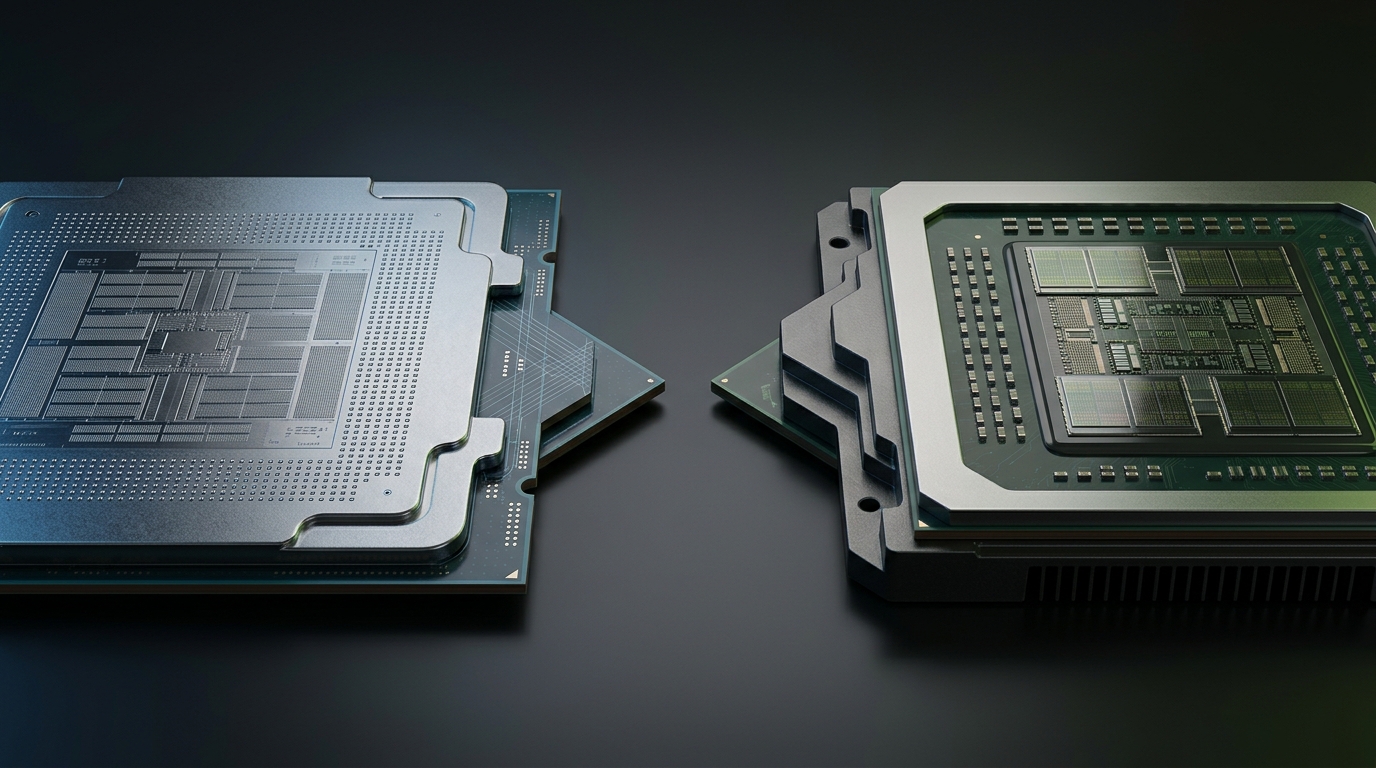
Google Tensor Processing Unit AI chip alongside an NVIDIA GPU, illustrating OpenAI's reported move to diversify its artificial intelligence computing hardware.
OpenAI is expanding its artificial intelligence computing infrastructure beyond Nvidia, reportedly planning to purchase Google's Tensor Processing Units (TPUs) as demand for the computing power needed to develop and operate advanced AI systems continues to grow.
The move could create an unusual business relationship between two companies competing for leadership in artificial intelligence. Google develops its own AI models and products, while OpenAI operates ChatGPT and other AI services that compete directly with Google's offerings.
According to a report by The Information, cited by TechRadar on November 1, 2026, OpenAI intends to purchase Google's specialized AI processors. The financial terms, number of chips involved, and delivery schedule have not been disclosed.
The reported purchase reflects a wider change in the AI industry. As companies spend increasingly large amounts on computing infrastructure, access to powerful processors is becoming a strategic priority. OpenAI appears to be pursuing a broader hardware strategy that includes Nvidia GPUs, Google's TPUs, and processors developed through its partnership with Broadcom.
Why OpenAI is looking beyond Nvidia
Nvidia has become one of the most important companies in the artificial intelligence industry because its graphics processing units are widely used to train and operate advanced AI models.
OpenAI is among the major customers relying on Nvidia hardware. Its GPUs support the development and operation of systems behind ChatGPT and other AI products.
However, depending heavily on a single hardware supplier can create challenges for a company with rapidly expanding computing requirements.
The AI industry is experiencing intense demand for processors, memory, networking equipment, and data-center capacity. As companies compete to secure enough hardware, diversifying suppliers can help reduce dependence on one ecosystem and provide additional options for scaling infrastructure.
OpenAI's reported interest in Google's TPUs suggests that the company wants more flexibility in how it obtains computing capacity.
This does not mean OpenAI is abandoning Nvidia. Rather, it is expanding the number of hardware platforms it can potentially use.
What are Google's Tensor Processing Units?
Google's Tensor Processing Units are specialized processors designed to accelerate machine-learning workloads.
Unlike general-purpose CPUs, TPUs are built specifically to handle the mathematical operations commonly used in artificial intelligence, particularly the large matrix calculations involved in training and running neural networks.
Google developed the processors for its own AI infrastructure, using them to support machine-learning systems across its products and cloud services.
For years, Google's TPUs were primarily associated with its internal computing operations and Google Cloud. The company has increasingly expanded their availability to external customers as demand for alternatives to Nvidia GPUs grows.
The processors are designed to support different AI workloads, including model training and inference.
Training involves teaching an AI model to recognize patterns and generate useful outputs from large amounts of data. Inference occurs when an already-trained model processes new information and produces a response.
Having access to alternative accelerators could give OpenAI additional options when deciding how to distribute these workloads across its infrastructure.
Google and OpenAI are competitors, but their relationship is changing
The reported chip purchase is particularly interesting because Google and OpenAI are direct competitors in the AI market.
Google develops Gemini and operates a broad ecosystem of AI-powered products, while OpenAI continues to expand ChatGPT and its associated developer and enterprise services.
Despite this competition, the two companies have already established commercial relationships.
OpenAI began renting Google's AI chips in 2025, according to TechRadar's reporting. This means the relationship around Google's computing infrastructure predates the latest reported purchase plans.
The companies have also agreed to make OpenAI's advanced AI models available through Google Cloud.
These arrangements demonstrate how competition in the AI industry does not necessarily prevent commercial partnerships.
Technology companies can compete over customers, products, and research while simultaneously buying infrastructure, software, or computing resources from one another.
For Google, selling access to its AI processors creates another potential revenue stream. For OpenAI, using Google's hardware could provide additional computing capacity without relying entirely on Nvidia's ecosystem.
OpenAI is also developing its own AI chips
Purchasing processors from Google is only one part of OpenAI's broader hardware strategy.
In June 2026, OpenAI announced a partnership with semiconductor company Broadcom to develop a custom AI processor.
The project is intended to give OpenAI greater control over the hardware used to support its AI systems.
Custom processors can be designed around the specific requirements of a company's workloads. This may help improve efficiency, optimize performance, and reduce some of the costs associated with relying exclusively on commercially available hardware.
TechRadar reported that OpenAI intended to deploy the custom-designed processor before the end of 2026.
The company is therefore pursuing several approaches simultaneously:
- Continuing to purchase Nvidia GPUs.
- Expanding access to Google's Tensor Processing Units.
- Developing custom AI hardware with Broadcom.
This diversified approach could become increasingly important as OpenAI's computing requirements grow.
Rather than depending on a single supplier, the company is positioning itself to obtain computing resources from multiple sources while gradually developing more control over its own hardware infrastructure.
The enormous cost of the AI computing race
The competition for AI hardware is becoming increasingly expensive.
Developing advanced models requires enormous computing resources, while operating popular AI services involves processing requests from millions of users and businesses.
These workloads require specialized processors, high-speed networking, advanced cooling systems, substantial electricity supplies, and large data centers.
Alphabet, Amazon, and Microsoft are collectively expected to spend as much as $600 billion on AI infrastructure during 2026, according to the figures cited in TechRadar's report.
Such investment illustrates the scale of the competition between major technology companies.
However, spending heavily on infrastructure does not automatically guarantee financial success. Investors are increasingly interested in how quickly these investments can generate revenue and whether the costs of building and operating AI systems can be justified by their commercial returns.
For companies such as OpenAI, securing access to computing hardware is therefore only part of the challenge. They must also ensure that the infrastructure can support sustainable business growth.
Google could strengthen its position in the AI chip market
The reported arrangement could also benefit Google beyond its existing AI products and cloud services.
Nvidia has historically held a dominant position in the market for AI accelerators, but major technology companies are increasingly developing or commercializing alternatives.
Google's TPUs are one of the most established alternatives.
By selling its processors to external customers, Google can turn technology originally developed for its own infrastructure into a broader commercial business.
The company has also been expanding its cloud partnerships and making its AI hardware more accessible to organizations that want alternatives to conventional GPU-based systems.
Alphabet's finance chief, Anat Ashkenazi, previously indicated that the company expected to recognize a small portion of revenue from TPU sales agreements by the end of 2026, with most of the revenue expected to be recognized in 2027.
A major customer relationship with OpenAI could strengthen Google's position in this market, although the financial value of the reported purchase has not been disclosed.
What this means for the future of AI infrastructure
OpenAI's reported decision to purchase Google's AI chips highlights an important development in the artificial intelligence industry.
The competition is no longer limited to building the most capable AI models. Companies are also competing to secure the processors, energy, data centers, and networking infrastructure required to develop and operate them.
Nvidia remains a major supplier, but Google, Broadcom, AMD, and other semiconductor companies are increasingly important to the broader AI hardware ecosystem.
For businesses adopting artificial intelligence, this competition could eventually create more choices in how AI workloads are deployed and priced.
More hardware suppliers may encourage innovation, improve access to specialized computing resources, and reduce dependence on a limited number of infrastructure providers.
However, the extent of those benefits will depend on hardware availability, performance, software compatibility, and the cost of operating each platform.
OpenAI's reported move does not signal the end of Nvidia's influence. Instead, it demonstrates that even some of Nvidia's largest customers are exploring ways to diversify their computing resources.
As AI systems become more sophisticated and expensive to operate, control over computing infrastructure could become just as important as the models themselves.
Russia Orders Apple and Microsoft to Retain User Messages for Three Years
Next Dispatch →Google Disrupts XCPE Botnet That Infected 1.3 Million Android TV Devices
Discussion (0)
Technical commentaryLeave a Reply
No comments yet. Be the first to share your thoughts!