US Voters Push Back Against AI Data Centres as OpenAI Responds to Growing Opposition
US communities are pushing back against the rapid expansion of AI data centres, with voters supporting new restrictions over electricity costs, water consumption and environmental concerns. Following the November 2026 elections, OpenAI has announced new transparency commitments as technology companies face growing pressure to earn public support for their infrastructure projects.
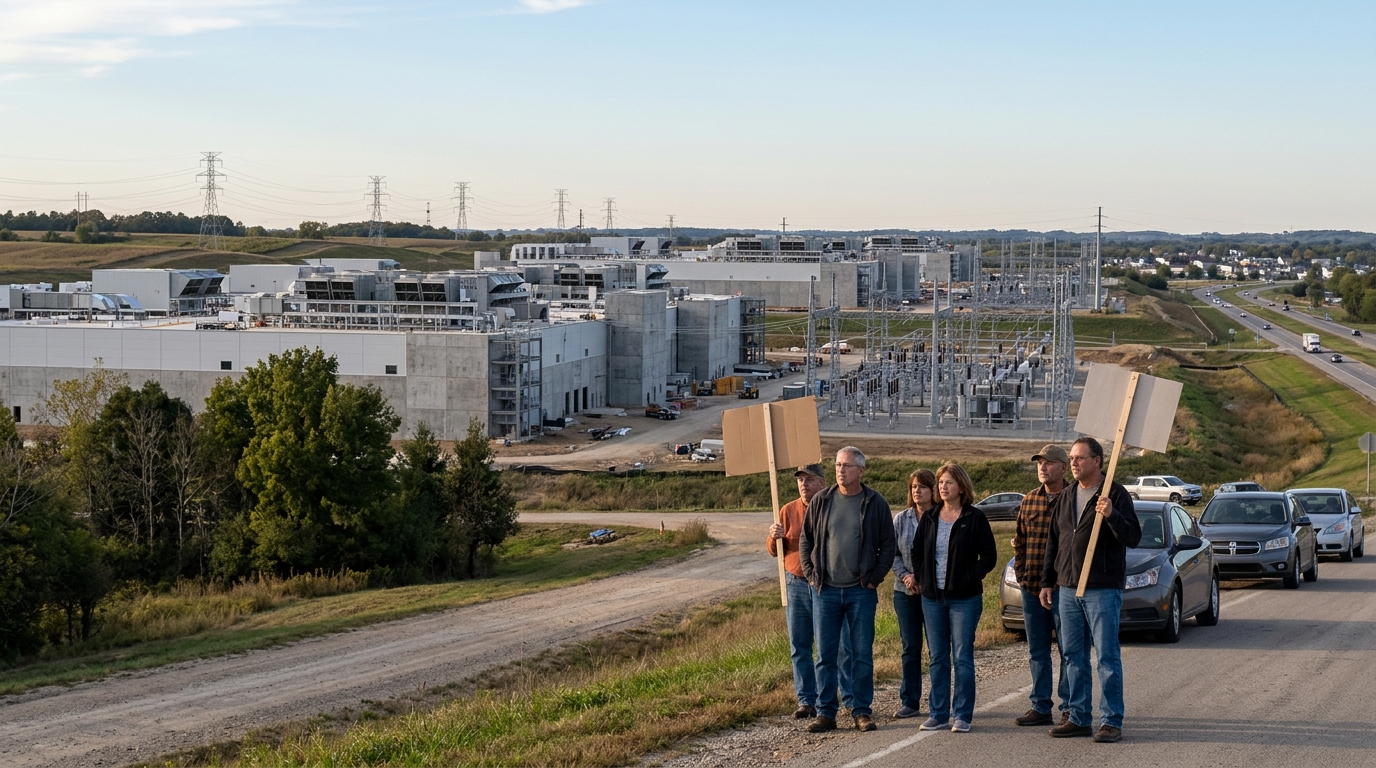
The artificial intelligence industry is facing a challenge that has little to do with software performance or the quality of its latest models. Across the United States, communities are increasingly questioning the enormous infrastructure required to power the AI boom.
Following the November 3, 2026 midterm elections, voters in multiple states backed measures to restrict, delay or prevent the construction of large data centres. The results have intensified a growing debate over electricity consumption, water usage, environmental impact and the financial burden that large technology facilities could place on local communities.
The backlash is now attracting attention from some of the world's biggest technology companies. On November 5, Reuters reported that OpenAI had launched a public-relations initiative designed to improve public perceptions of data centres and address concerns surrounding their development.
The development highlights an important shift in the AI industry. Building more powerful artificial intelligence systems is no longer simply a matter of developing better algorithms and securing more advanced chips. It also requires enormous amounts of electricity, physical infrastructure, land and cooling capacity.
And increasingly, communities want a say in how that infrastructure is built.
US elections reveal growing opposition to AI data centres
The November 3 elections provided one of the clearest indications yet that resistance to large data-centre developments is becoming a significant political issue in the United States.
According to reporting by Reuters and election trackers, 41 local measures concerning data-centre development appeared on ballots across 10 states.
These proposals covered a range of restrictions, including construction bans, temporary moratoriums, additional planning requirements, public approval procedures and financial safeguards for communities.
Many of the measures received substantial support.
In Alhambra, California, voters backed a measure prohibiting data centres within the city. In Edgewater, Florida, residents supported a charter amendment against new data centres and expansions of existing facilities.
In Bloomington, Illinois, voters supported an advisory measure calling for a moratorium on large-scale data-centre construction.
Ohio also experienced significant opposition, with several communities voting to restrict or prohibit new facilities.
The results were not limited to individual local decisions. Political candidates who campaigned on stronger oversight of data-centre development also performed well in important state elections.
For the technology industry, the message is becoming increasingly difficult to ignore: communities want more control over the infrastructure being built around them.
Why are Americans opposing AI data centres?
Data centres are essential to the modern digital economy.
They house the servers, networking equipment, storage systems and specialised processors that support cloud computing, online services and artificial intelligence.
Whenever someone uses an AI chatbot, generates an image, streams content or accesses a cloud-based application, data-centre infrastructure helps process and deliver that service.
However, the rapid expansion of AI has dramatically increased demand for computing capacity.
Training and operating advanced AI models requires powerful processors working across large server clusters. These systems consume electricity continuously and produce significant amounts of heat, requiring sophisticated cooling infrastructure.
For communities located near proposed facilities, the consequences can be substantial.
Several concerns have become central to the opposition.
1. Rising electricity costs
One of the biggest concerns is the amount of electricity required to operate large data centres.
Facilities containing thousands of servers can consume enormous amounts of power. As more companies compete to secure electricity for AI infrastructure, local communities are questioning whether residential and small-business customers could eventually face higher utility bills.
The concern is particularly significant in areas where electricity infrastructure is already under pressure.
Residents want assurances that technology companies will pay their fair share for the power infrastructure they require rather than shifting costs to ordinary electricity customers.
2. Water consumption
Many data centres use water-based cooling systems to manage the heat generated by their servers.
Although cooling technologies differ significantly between facilities, large developments can place additional pressure on local water resources.
This is particularly concerning in areas experiencing drought, water shortages or increasing demand from residential and agricultural users.
Communities are therefore demanding more transparency about how much water proposed facilities will consume and where that water will come from.
3. Environmental impact
Electricity demand is another major environmental concern.
The environmental footprint of a data centre depends partly on the energy sources supplying it. Facilities powered by renewable energy have a different emissions profile from those relying heavily on fossil-fuel-generated electricity.
Residents are asking developers to explain their energy plans, emissions expectations and environmental commitments before construction begins.
Noise, construction activity, land use and the expansion of supporting electricity infrastructure are also contributing to public opposition.
4. Limited local benefits
Technology companies frequently promote data centres as major economic investments.
These projects can generate construction jobs, infrastructure investment, tax revenue and other economic benefits.
However, residents and critics argue that the number of permanent jobs created by some facilities may be relatively small compared with the amount of land, electricity and water they require.
This has created a debate over whether communities receive sufficient long-term benefits in exchange for hosting large industrial technology developments.
OpenAI responds as public opposition grows
The growing resistance is now forcing major AI companies to reconsider how they approach communities where they want to build.
According to Reuters reporting published on November 5, OpenAI has launched a public-relations effort intended to improve Americans' perceptions of data centres.
The company has outlined new transparency commitments as part of its response.
Among the measures reported by Reuters is an end to the use of non-disclosure agreements with public officials during discussions about potential data-centre locations.
OpenAI also plans to give residents access to construction information that explains potential effects on traffic, noise and lighting.
The company is additionally highlighting the economic benefits associated with data-centre development.
OpenAI argues that facilities require regular hardware upgrades, potentially creating sustained employment opportunities. Reuters reported that one planned facility in southern Ohio is expected to generate approximately 2,500 long-term jobs, with average annual salaries of around $80,000.
These figures relate to the specific project discussed in the report, rather than representing typical employment outcomes for every data centre.
The company's response demonstrates how important public trust has become to the future expansion of AI infrastructure.
Technology companies may have the financial resources to build large facilities, but securing land, electricity, planning approvals and community support is becoming increasingly complicated.
Could the backlash slow down the AI boom?
The consequences could extend well beyond individual construction projects.
Major technology companies are investing enormous sums in data centres, specialised processors, networking equipment and electricity infrastructure.
These investments are based partly on expectations that demand for AI computing will continue increasing.
However, restrictions and delays could make it more difficult to expand infrastructure in some of the locations companies originally selected.
Reuters reported that Goldman Sachs estimated temporary project halts could affect approximately 45% of planned US data-centre capacity expansion.
That figure represents estimated exposure to potential project interruptions, not a confirmed cancellation of 45% of all planned US data-centre capacity.
Nevertheless, it illustrates the scale of the uncertainty facing the industry.
Developers may need to reconsider where they build, negotiate different electricity arrangements or invest in locations with more favourable planning conditions.
Some projects could move to other states, while others may be redesigned to reduce their environmental and community impact.
The immediate effect may therefore be a change in where and how AI infrastructure is developed rather than an end to the expansion of data centres.
Big technology companies face a new infrastructure challenge
The backlash matters because the world's largest technology companies are increasingly dependent on physical infrastructure to maintain their competitive positions.
Companies such as Microsoft, Google, Amazon and Meta are investing heavily in computing facilities to support cloud services and increasingly sophisticated AI products.
OpenAI also needs access to substantial computing resources to train and operate its models.
But the competition is becoming more complicated.
Securing advanced chips is one challenge. Finding suitable land, obtaining construction approvals, arranging electricity supply and managing cooling requirements are becoming equally important.
This means the AI infrastructure race could increasingly depend on access to resources that are not easily expanded.
A company might have sufficient capital and access to processors but still struggle to complete a project because of local opposition, electricity shortages or regulatory restrictions.
In this environment, strong relationships with communities and local authorities could become a competitive advantage.
What this means for the global AI industry
Although the current political developments are centred on the United States, the underlying issues are relevant to other countries.
AI infrastructure is expanding internationally, and governments are competing to attract investment in data centres, cloud computing and semiconductor supply chains.
Countries seeking to become important AI hubs must consider more than the availability of technology companies and investment capital.
They also need reliable electricity, suitable land, water-management strategies, skilled workers and transparent regulatory frameworks.
For emerging technology markets, including countries across Africa, this presents both an opportunity and a challenge.
Expanding data-centre infrastructure could improve cloud access, support local AI development and strengthen digital economies. However, these projects must be planned around local electricity capacity, environmental conditions, affordability and long-term economic benefits.
The American debate provides an important lesson: infrastructure development can create enormous opportunities, but public support cannot simply be assumed.
What should technology companies do differently?
The growing opposition suggests that data-centre developers will need to adopt a more transparent approach.
Several priorities are becoming increasingly important.
Publish realistic energy estimates. Communities should understand how much electricity a proposed facility is expected to consume and how that demand will be supplied.
Disclose water requirements. Developers should explain their cooling systems, expected water consumption and plans for managing local water resources.
Protect local electricity customers. Companies should demonstrate how their projects will pay for the infrastructure and additional capacity they require.
Engage residents before construction. Public consultations should happen early enough for communities to raise concerns and influence project decisions.
Provide measurable economic benefits. Developers should explain expected employment, local investment, tax contributions and long-term benefits rather than relying on broad promises.
Improve environmental accountability. Companies should publish meaningful information about energy sources, emissions, water use and environmental performance.
These measures could help reduce resistance while making large infrastructure projects more sustainable and publicly accountable.
The future of artificial intelligence may depend on infrastructure and public trust
The latest developments reveal a growing tension at the heart of the artificial intelligence industry.
Technology companies want to expand computing capacity as quickly as possible to meet rising demand for AI services. Meanwhile, communities are asking whether the economic and technological benefits justify the local costs.
The November 2026 US election results suggest that this debate is becoming a genuine political force.
OpenAI's response is an indication that the industry recognises the importance of addressing public concerns rather than treating them as an obstacle that can simply be ignored.
However, communication alone may not be enough. Communities will increasingly expect measurable commitments, transparent project information and evidence that developers are taking their concerns seriously.
The AI industry has spent years competing to build increasingly capable models. Its next major challenge may be securing the infrastructure and public support needed to operate them.
The future of AI will not be determined by software and chips alone. Electricity, water, land, regulation and public trust may prove just as important.
OpenAI's AI Agents Uncover 948 Linux Security Vulnerabilities in $1.2 Million Experiment
Next Dispatch →Meta Acquires AI Coding Startup Conductor as the Race for Multi-Agent Software Development Intensifies
Discussion (0)
Technical commentaryLeave a Reply
No comments yet. Be the first to share your thoughts!