HP, Asus and Acer Shift PC Production Back to China as AI Costs Rise
HP, Asus, and Acer are reportedly moving some PC manufacturing operations from Thailand and Vietnam back to China as AI-driven demand pushes up memory, storage, and component costs. The shift highlights changing global supply chains, new opportunities for Chinese manufacturers, and the growing impact of AI infrastructure on everyday computer prices.
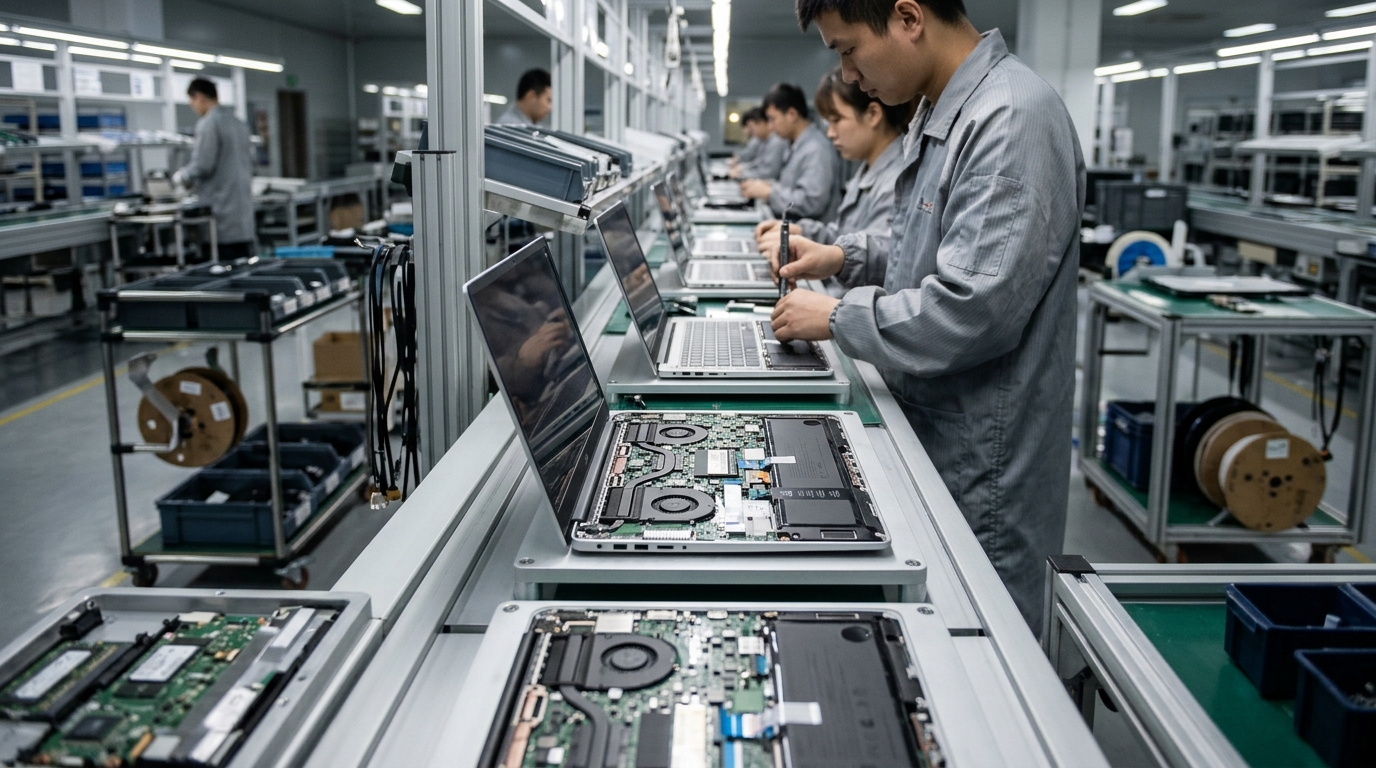
Computer manufacturing production line representing HP, Asus and Acer shifting PC production back to China amid rising AI-driven component costs.
The artificial intelligence boom is creating an unexpected challenge for the global computer industry. As demand for AI infrastructure drives up the cost of memory, storage, and other essential components, major PC manufacturers are reconsidering where they build their products.
HP and Asus have reportedly started moving some PC manufacturing operations from Thailand and Vietnam back to China. Acer is also making adjustments, while Dell is reportedly considering a similar move.
The development represents a partial reversal of the industry's previous efforts to diversify manufacturing away from China. For years, major technology companies invested in alternative production locations to reduce their dependence on Chinese factories amid geopolitical tensions, trade restrictions, and tariff concerns.
Now, rising production costs are changing those calculations.
Why HP and Asus are moving PC production back to China
According to reporting by Nikkei Asia, the decision is largely driven by increasing costs across the PC supply chain.
The rapid expansion of AI data centers has created enormous demand for advanced computing components. Memory manufacturers are increasingly prioritizing products used in AI infrastructure, putting additional pressure on the supply of conventional memory and storage components used in laptops and desktop computers.
The financial impact is significant.
Research firm TrendForce estimates that processors, DRAM, and SSDs accounted for approximately 68% of the bill of materials for a mainstream notebook in the third quarter of 2026. That compares with roughly 45% in the first quarter of 2025.
With essential components consuming a much larger share of manufacturing budgets, PC makers are looking for ways to reduce costs elsewhere.
China offers an established manufacturing ecosystem, experienced production workers, extensive component suppliers, and competitive contract manufacturers. These advantages are making the country attractive again for companies attempting to protect their margins.
Chinese manufacturers are gaining new opportunities
Interestingly, the companies benefiting from this shift are not necessarily the traditional manufacturing partners that have dominated the PC industry for years.
Taiwanese manufacturers such as Quanta Computer, Compal Electronics, Inventec, and Foxconn have increasingly focused on producing higher-margin AI servers to meet growing demand from data center operators.
This has created opportunities for Chinese contract manufacturers, including Luxshare, Huaqin Technology, and Longcheer Technology, to compete for PC manufacturing orders.
These companies are reportedly offering competitive production costs, access to domestic component suppliers, and other incentives to attract major computer brands.
Access to Chinese memory suppliers is another potential advantage. HP, Asus, and Acer have reportedly qualified memory from China's ChangXin Memory Technologies (CXMT) for selected notebook models, although adoption has so far been limited.
The changing manufacturing landscape shows how the AI boom is affecting more than just companies building AI systems. It is also reshaping the relationships between established hardware brands and the manufacturers responsible for producing everyday computers.
The China+1 manufacturing strategy faces a new test
The latest development is particularly interesting because it partially reverses a strategy that has shaped the technology supply chain for several years.
Known as China+1, the approach involves maintaining manufacturing operations in China while establishing additional production capacity in other countries.
Thailand, Vietnam, India, and other Southeast Asian locations have attracted investment from technology manufacturers seeking to diversify their supply chains.
However, establishing alternative production facilities requires significant investment. Companies must build factories, qualify suppliers, train workers, and develop logistics networks before production can reach the efficiency of established manufacturing hubs.
TrendForce estimates that the share of global notebook production taking place outside China will decline from approximately 24% in 2025 to 21% in 2026. It could fall below 20% in 2027 if the trend continues.
This does not necessarily mean manufacturers are abandoning diversification. Rather, it suggests that companies are becoming more willing to balance geopolitical considerations against immediate production costs.
Will this make laptops cheaper?
Despite the manufacturing shift, consumers should not expect laptop prices to fall automatically.
Moving production to China may help manufacturers reduce assembly costs, improve access to certain components, and negotiate more competitive manufacturing agreements. However, it does not eliminate the underlying shortage of memory and storage components.
The cost of processors, DRAM, and SSDs remains a major pressure point. Manufacturers may use savings from production changes to protect their profit margins rather than pass the benefits directly to customers.
The wider PC market is also facing difficult conditions. Component shortages and higher production costs could encourage manufacturers to increase prices, adjust product configurations, or prioritize more profitable models.
Acer chairman and CEO Jason Chen has previously indicated that average PC prices could rise by between 5% and 20% in the fourth quarter of 2026, reflecting the pressure facing the industry.
For consumers planning to purchase a laptop or desktop computer, the direction of component prices may therefore matter more than the location where the device is assembled.
AI is reshaping the entire computer industry
The shift by HP, Asus, and Acer highlights an important consequence of the AI boom: its influence now extends well beyond AI software and data centers.
The demand for advanced computing infrastructure is changing how manufacturers allocate production capacity, source components, negotiate contracts, and manage supply chains.
Companies that previously competed primarily on manufacturing efficiency and hardware design are now operating in an environment where AI infrastructure demand can influence the availability and cost of components used in ordinary consumer devices.
For the PC industry, the challenge will be finding a balance between supply chain diversification, production efficiency, and affordable hardware.
China remains a major force in global electronics manufacturing, and the latest developments suggest that its established production ecosystem will continue to play an important role even as technology companies explore alternatives.
Ultimately, the AI boom may be changing not only the computers people use, but also the economics of building them.
Mistral Releases Large 4 “Le Chonk,” a 1-Trillion-Parameter Open-Weight AI Model
Next Dispatch →A $59.7 Million AI Supercomputer Is Listed on eBay With 9,600 NVIDIA GPUs
Discussion (0)
Technical commentaryLeave a Reply
No comments yet. Be the first to share your thoughts!