Why Your Business Needs More Than Paid Ads: The Importance of Brand Marketing
Paid advertising can generate immediate leads and sales, but relying on it alone can limit long-term business growth. Discover why brand marketing and performance marketing need to work together, how AI is changing customer discovery, and how businesses can build recognition, trust and sustainable customer acquisition.
Many businesses approach digital marketing with one primary objective: getting more customers as quickly as possible.
They invest in Google Ads, Facebook campaigns, Instagram promotions and other paid advertising channels. They monitor clicks, impressions, enquiries and sales, adjusting their budgets to improve results.
These activities are important. Paid advertising can help a business reach potential customers, generate leads and increase sales. However, there is a problem with relying on it as the foundation of an entire marketing strategy.
Advertising can help people find your business, but it cannot replace the work required to make them recognize, remember and trust it.
A company can spend heavily on advertisements and still struggle to build a sustainable customer base if people have little awareness of its brand or do not understand what makes its products and services worth choosing.
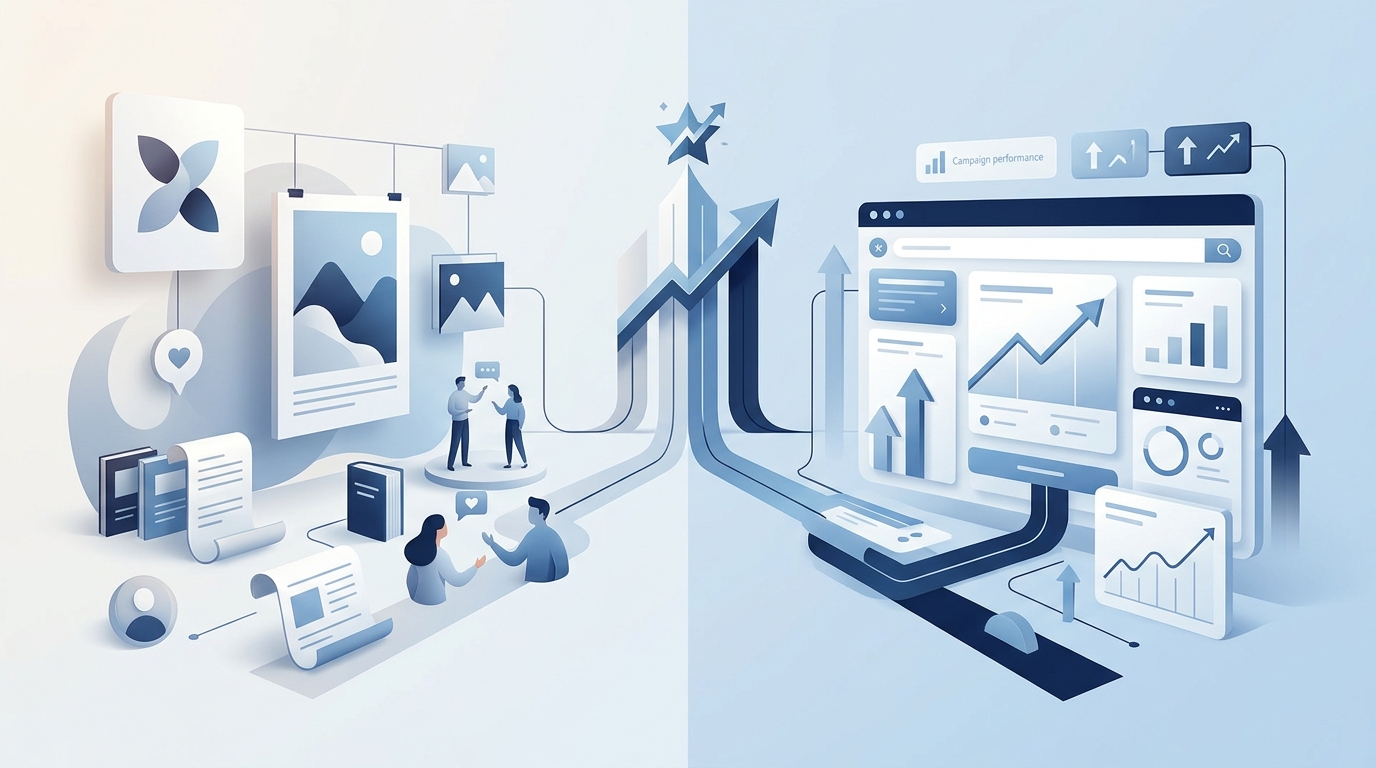
This is why brand marketing and performance marketing need to work together.
As artificial intelligence changes how people discover businesses, compare products and make purchasing decisions, the relationship between these two marketing approaches is becoming even more important.
What Is the Difference Between Brand Marketing and Performance Marketing?
Although both approaches aim to grow a business, they solve different marketing problems.
Brand marketing focuses on building awareness, recognition, trust and preference over time. It helps people understand what a company represents, what it offers and why they should consider it.
Examples include:
- Publishing educational and informative content.
- Developing a consistent brand identity.
- Sharing customer stories and testimonials.
- Participating in relevant industry events.
- Producing videos that explain a company's expertise.
- Building a recognizable presence across social media and other digital channels.
- Investing in public relations and credible industry coverage.
Performance marketing, on the other hand, focuses on measurable actions. These may include website visits, enquiries, purchases, app installations, subscriptions and other conversions.
Common examples include:
- Google Search advertising.
- Paid social media campaigns.
- Retargeting advertisements.
- Lead generation campaigns.
- Affiliate marketing.
- Conversion-focused landing pages.
- Promotional campaigns designed to generate immediate sales.
The distinction is not that one approach creates value while the other does not. They contribute to different parts of the customer journey.
Brand marketing helps create the conditions for future demand. Performance marketing helps businesses reach people who are ready to take action and capture existing interest.
A successful marketing strategy needs to account for both.
The Problem With Relying Too Heavily on Paid Advertising
Paid advertising offers something that many businesses find attractive: measurable and relatively immediate results.
A company can launch a campaign, define its target audience, set a budget and begin receiving traffic or enquiries.
This makes performance marketing particularly appealing to businesses under pressure to generate revenue.
However, an advertising campaign does not automatically create long-term brand value.
Consider a business that sells cybersecurity services.
It launches a Google Ads campaign targeting people searching for cybersecurity companies. The campaign generates enquiries, and some visitors become customers.
The business then increases its advertising budget to generate more leads.
Initially, this might work well. But as the company continues targeting similar audiences and search terms, it may encounter higher competition, rising acquisition costs or a limited pool of people actively looking for the service.
The company is capturing existing demand, but it may not be doing enough to create new demand.
Now consider what happens when that same business consistently publishes useful cybersecurity advice, explains common online threats, shares practical security recommendations and demonstrates its expertise.
People who were not actively searching for a cybersecurity provider may discover the company through its content. Some may begin following it, sharing its resources or remembering its name.
When those individuals eventually need cybersecurity services, the company is no longer an unfamiliar option.
Its brand has already started building recognition and trust.
This is the additional value that brand marketing can create.
Why Brand Recognition Makes Advertising More Effective
People rarely make every purchasing decision based on a single advertisement.
They may encounter a company through a social media post, hear about it from someone they trust, read an article, watch a product demonstration and later search for its name.
By the time they are ready to buy, they may already have an impression of the business.
That impression can influence whether they click an advertisement, visit the website, request a quote or choose a competitor.
A recognizable brand can make the decision process easier because potential customers have some familiarity with the company before they encounter its sales message.
This does not mean that brand recognition guarantees a purchase. Price, service quality, availability, customer experience and other factors still matter.
However, it helps explain why marketing performance should not be judged exclusively by the number of clicks generated by individual campaigns.
Brand familiarity, trust and preference can influence how effectively a business converts future demand.
Research and marketing analysis have repeatedly explored the relationship between long-term brand building and short-term sales activation. Harvard Business Review, for example, has argued that brand building and performance marketing should not be treated as competing investments because both can contribute to business outcomes.
https://hbr.org/2023/05/how-brand-building-and-performance-marketing-can-work-together
AI Is Changing How Customers Discover and Choose Businesses
The relationship between brand and performance marketing is becoming more important as artificial intelligence changes online discovery.
People increasingly use conversational AI tools to research products, compare services and explore potential solutions.
Instead of performing several separate searches, a person might ask an AI assistant to recommend a suitable software provider, compare cybersecurity services or explain what to consider when choosing a website development company.
These experiences can combine discovery, research and evaluation into a much shorter process.
Microsoft's research cited in the original Search Engine Land article found that journeys involving Copilot saw 53% more purchases within 30 minutes of an interaction. It also reported that shopping-intent journeys were 194% more likely to result in a purchase.
These are Microsoft-specific findings, not universal conversion benchmarks. Nevertheless, they illustrate how AI-assisted discovery may influence the speed and structure of purchasing decisions. https://searchengineland.com/beyond-demand-capture-brand-marketing-499981
This creates a new challenge for businesses.
When an AI system recommends or discusses a company, customers may have very little time to form an impression before deciding whether to explore its services.
A recognizable brand with clear information, credible content and a strong reputation has an advantage in that moment.
Businesses should therefore think beyond the next advertisement or website click. They need to build an online presence that helps customers understand who they are and why their services deserve consideration.
Why Measuring Every Conversion Through Clicks Can Be Misleading
One of the biggest advantages of performance marketing is measurement.
Advertisers can track clicks, conversions, cost per acquisition and return on advertising spend. These metrics help businesses evaluate whether campaigns are producing measurable results.
However, the customer journey is not always as straightforward as an advertisement leading directly to a purchase.
Someone might watch a company's video, see a social media post several days later, ask an AI assistant about the company and eventually visit its website by typing the business name into a browser.
If the company only measures the final website visit, it may overlook the earlier interactions that helped create the purchase.
This is particularly relevant as customers encounter brands across search engines, social media, video platforms, AI assistants and other digital channels.
It is becoming increasingly difficult to assign every sale to one interaction with complete confidence.
Businesses should still measure conversions and advertising efficiency. However, they should also examine broader indicators of marketing effectiveness.
For example:
Performance marketing metrics:
- Number of conversions.
- Cost per acquisition.
- Return on advertising spend.
- Qualified leads.
- Customer acquisition cost.
- Conversion rate.
Brand marketing metrics:
- Brand awareness.
- Brand recognition.
- Reach and frequency.
- Video engagement.
- Branded search activity.
- Direct website visits.
- Customer preference and consideration.
These metrics answer different questions.
Performance metrics help establish whether campaigns are generating actions. Brand metrics help assess whether the business is becoming more familiar and relevant to its intended audience.
Neither group should be used as a substitute for the other.
Creative Quality and Accessibility Matter More Than Businesses Realize
A marketing campaign can have an appropriate budget, a carefully selected audience and an effective advertising platform, yet still produce disappointing results if the message is unclear.
People need to understand what a business offers and why it matters.
This is where creative quality becomes important.
An advertisement should communicate a meaningful benefit rather than simply display a company name, list several services or use attractive graphics without a clear message.
For example, a cybersecurity company could publish an advertisement that says:
"Complete cybersecurity solutions for businesses."
That statement explains the general category of service, but it does not necessarily communicate a compelling reason to pay attention.
A more specific message could be:
"Protect your business from phishing, data theft and unauthorized access."
The second message gives potential customers a clearer understanding of the problems the company addresses.
Accessibility is equally important.
Small text, poor colour contrast, confusing layouts, difficult navigation and complicated enquiry forms can make it harder for people to understand or respond to a campaign.
Businesses should ensure that their advertisements, landing pages and websites communicate clearly across different devices and user needs.
Good creative is not simply about looking professional. It is about helping the right people understand the value being offered.
How Businesses Can Balance Brand Marketing and Performance Marketing
There is no single budget allocation that works for every company.
A new business with limited resources may need to prioritize lead generation while gradually establishing its brand. A mature company with an existing customer base may have greater opportunities to invest in brand awareness, retention and long-term market positioning.
The right balance depends on the business's objectives, competition, customer acquisition costs, sales cycle and available resources.
However, businesses can use the following approach to make better decisions.
1. Understand Whether You Need to Capture or Create Demand
Before increasing advertising expenditure, identify the actual problem.
Are enough potential customers already searching for your products or services, but your business is failing to reach them?
Or are too few people aware of your business and what it offers?
If customers are actively searching but choosing competitors, improving search advertising, landing pages and conversion processes may be appropriate.
If very few people know the company exists, increasing paid search expenditure alone may not solve the problem.
Brand awareness and educational content may be necessary to introduce the business to a wider audience.
2. Establish a Recognizable Brand Identity
Customers should be able to recognize your business and understand what it stands for.
This involves more than choosing a logo and brand colours.
Businesses need consistent messaging, a clear value proposition, professional visual communication and a recognizable tone across their websites, advertisements, social media accounts and other customer touchpoints.
Consistency helps prevent the company from appearing like a completely different business on every platform.
3. Invest in Useful Content
Content marketing provides a practical way to build brand recognition while helping potential customers understand a company's expertise.
Businesses can publish:
- Educational blog articles.
- Industry insights and commentary.
- Product demonstrations.
- Frequently asked questions.
- Customer success stories.
- Short educational videos.
- Practical guides and downloadable resources.
The content should address real customer questions rather than exist simply to fill a publishing calendar.
Useful content can attract people who are not immediately ready to purchase but may become customers later.
4. Keep Performance Advertising Accountable
Brand marketing should not become an excuse to stop measuring business results.
Paid advertising still needs clear objectives, realistic budgets and regular performance reviews.
Businesses should monitor how much they spend to acquire customers, whether the leads generated are relevant and whether campaigns contribute to profitable growth.
They should also review landing pages, conversion rates and the quality of the customer experience.
When an advertising campaign is underperforming, the solution may involve improving the offer, creative message, targeting or website rather than simply increasing the budget.
5. Measure the Impact of Both Approaches
A business should not expect every brand campaign to produce immediate sales, just as it should not judge every performance campaign solely by the number of impressions it generates.
Instead, establish appropriate indicators for each activity.
For brand initiatives, monitor changes in awareness, branded searches, direct traffic, audience engagement and customer consideration.
For performance campaigns, evaluate conversions, qualified leads, acquisition costs and revenue.
Where resources permit, businesses can also use controlled experiments, customer surveys and broader marketing measurement methods to understand how different activities contribute to growth.
The purpose is to develop a clearer picture of what is working, not to force every marketing activity into one measurement model.
A Practical Example: How a Small Technology Business Can Apply This
Consider a small technology company offering website development, software solutions and cybersecurity services.
If the company relies entirely on paid advertising, it may receive enquiries from people who are already searching for those services.
That is useful, but it limits its ability to reach potential customers who have not yet identified a provider or even recognized the problem they need to solve.
A more balanced strategy could look like this:
Brand-building activities:
- Publish articles explaining why businesses need secure, well-maintained websites.
- Share practical cybersecurity advice.
- Produce short videos demonstrating common technology problems and their solutions.
- Publish case studies showing completed projects and measurable outcomes.
- Maintain a consistent, professional presence across social media platforms.
Performance activities:
- Run search advertisements targeting people looking for website development.
- Promote specific cybersecurity services to relevant audiences.
- Use dedicated landing pages for individual services.
- Retarget website visitors where appropriate and permitted.
- Track qualified enquiries and customer acquisition costs.
The two approaches support each other.
Educational content introduces the company to potential customers. A recognizable brand makes the company easier to remember. Paid advertising helps reach people with immediate needs and encourages them to take action.
Over time, the business can build a stronger foundation than one dependent entirely on purchasing advertising traffic.
The Businesses That Grow Will Think Beyond the Next Click
Digital marketing is becoming more sophisticated, but one important principle remains unchanged: customers are more likely to consider businesses they recognize, understand and trust.
Paid advertising is valuable because it helps companies reach people and generate measurable actions. Brand marketing is equally important because it helps create familiarity, credibility and future demand.
Artificial intelligence is making the relationship between the two even more significant by changing how people discover, research and evaluate businesses.
Companies that focus exclusively on immediate conversions risk overlooking the activities that make future conversions possible.
The answer is not to abandon paid advertising or spend blindly on brand awareness. It is to understand what each investment is supposed to achieve and measure it accordingly.
A strong marketing strategy does not just help people find your business. It gives them a reason to remember it, trust it and choose it.
AI Is Changing Digital Advertising: 6 Marketing Trends Businesses Should Watch in 2026
Next Dispatch →Singapore Airlines Data Breach: 46,000 Booking Records Affected by Third-Party Cyberattack
Discussion (0)
Technical commentaryLeave a Reply
No comments yet. Be the first to share your thoughts!